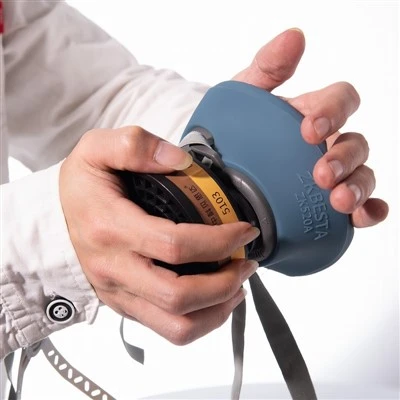
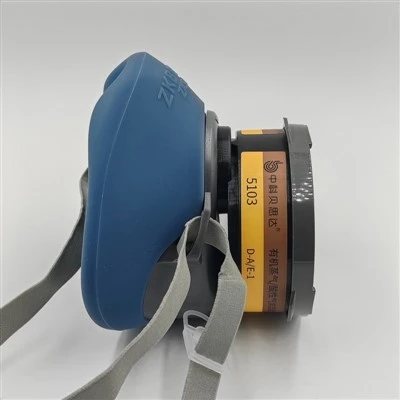
An exhalation valve in a filtering facepiece (FFP2/FFP3) functions as a one-way mechanical diaphragm designed to minimize exhalation resistance and reduce internal heat accumulation. From a procurement and engineering standpoint, the valve assembly must maintain a seal integrity that prevents unfiltered air ingress while allowing rapid egress of exhaled breath. For industrial buyers, validating the valve's durability and its impact on the mask's Total Inward Leakage (TIL) is critical for ensuring compliance with EN149:2001+A1:2009 standards.
Ⅰ:Fluid Dynamics and Mechanical Construction
The efficiency of a valved respirator relies on the precise calibration of the valve's cracking pressure-the minimum pressure required to open the valve during exhalation.
Valve Architecture
A standard industrial exhalation valve assembly typically consists of three components:
Valve Housing: Rigid plastic structure (often Polypropylene) integrated into the mask body via ultrasonic welding.
Valve Cover: Protects the internal membrane from physical damage and directs airflow outward.
Diaphragm/Seal: A flexible component (usually synthetic rubber or silicone) that seals against the valve seat during inhalation.
Resistance Parameters
In high-exertion environments (e.g., construction, mining), breathing rates can exceed 30 breaths per minute with tidal volumes up to 2.0 liters. Without a valve, the filter media itself creates resistance against exhaled air.
Inhalation Resistance: Air passes through the filter media (FFP2/FFP3 layers).
Exhalation Resistance: Air bypasses the filter media via the valve.
Engineering Data:
According to EN149:2001+A1:2009 standards, the maximum allowable exhalation resistance is strictly regulated. High-quality valved masks, such as the ZKBESTA FFP2 NR (ZKG9502V), typically demonstrate exhalation resistance values ≤ 150 Pa (at 95 L/min), significantly lower than the standard maximum of 240 Pa for non-valved equivalents under load. This reduction in back-pressure decreases the physiological burden on the wearer, reducing fatigue during extended shifts.
Ⅱ:Thermal Management and Moisture Control
Heat and humidity buildup inside a respirator compromises both comfort and filtration efficiency over time.
Condensation Risks
When warm, moist exhaled air interacts with cooler filter media, condensation occurs. In cold environments or high-humidity settings, this moisture can degrade the electrostatic charge of the melt-blown polypropylene layers, potentially reducing filtration efficiency (NaCl and Paraffin oil tests).
The Valve Function
By diverting warm, moist air directly out of the mask, the valve maintains a drier internal environment.
Temperature Reduction: Lowers the micro-climate temperature inside the facepiece.
Filter Longevity: Prevents the filter media from becoming saturated with moisture, maintaining low inhalation resistance for a longer duration.
Ⅲ:Material Durability: Synthetic Rubber vs. Standard Elastomers
The longevity of the exhalation valve depends heavily on the material properties of the diaphragm. Procurement specifications should dictate the use of high-grade synthetic rubber or silicone over standard natural rubber or low-grade PVC.
|
Feature |
High-Grade Synthetic Rubber/Silicone |
Standard/Low-Grade Rubber |
|
Elastic Recovery |
Returns to original shape after >10,000 cycles |
Prone to deformation (set) over time |
|
Temperature Resistance |
Stable from -20°C to +60°C |
Hardens in cold; softens in heat |
|
Chemical Resistance |
Resistant to oxidation and ozone |
Degrades faster when exposed to UV/Ozone |
|
Seal Integrity |
Maintains <1.8% TIL (FFP3 standard) |
Risk of leakage increases with age |
ZKBESTA utilizes ultrasonic welding to fuse the valve housing to the mask body, ensuring that the valve assembly does not detach under the maximum inhalation/exhalation forces defined in EN149 testing protocols.
Ⅳ:Compliance and Safety Considerations
While valves offer ergonomic benefits, they introduce specific constraints regarding sterile environments and source control.
Sterile Environments
In pharmaceutical manufacturing or cleanrooms (ISO Class 5-8), exhaled air must be filtered to protect the product. Valved masks are generally prohibited in these settings unless the valve itself contains an exhaust filter (rare in disposable FFP2/FFP3).
Source Control (Infection Control)
During pandemics or in medical settings, valved masks may not be suitable if the primary goal is preventing the wearer from infecting others, as the exhaled air is unfiltered. However, for industrial dust, silica, and welding fume protection, the valve is a standard safety feature.
Fit Testing Implications
The presence of a valve slightly alters the internal volume and airflow dynamics. Fit testing (EN136:1998 or OSHA protocols) must be conducted on the specific valved model to ensure the negative pressure seal holds during the negative pressure fit check.
Ⅴ:Application in ZKBESTA Product Lines
ZKBESTA integrates optimized valve designs across its FFP2 and FFP3 ranges to balance protection with wearability.
FFP2 Filtering Half Mask (ZKG9502V): Features a high-performance exhalation valve designed to reduce heat buildup. It meets the ≥94% filtration efficiency requirement while keeping breathing resistance low.
FFP3 Particle Filtering Half Mask (ZKG8912V): Designed for high-hazard environments (e.g., asbestos, hard wood dust). The valve system here is critical because the denser FFP3 filter media naturally imposes higher inhalation resistance. The valve compensates by virtually eliminating exhalation resistance.
For detailed engineering drawings and airflow resistance curves, refer to the CE certified FFP3 respirator specifications or the FFP2 technical data sheet.
FAQ
Q: Does the exhalation valve affect the CE certification or EN149 classification of the mask?
A: No. The valve is a structural component tested as part of the complete assembly. ZKBESTA valved masks undergo rigorous testing for Total Inward Leakage (TIL) and breathing resistance to maintain their FFP2 or FFP3 classification under EN149:2001+A1:2009.
Q: What is the service life of the exhalation valve diaphragm?
A: The valve is ultrasonically welded and not user-replaceable. The synthetic rubber diaphragm is engineered to last the entire service life of the respirator (typically one shift or until soiled), maintaining seal integrity for thousands of breathing cycles.
Q: Can these valved masks be used in explosive atmospheres (ATEX zones)?
A: Standard plastic valves are generally non-sparking. However, for specific ATEX zone requirements, buyers should verify if the specific mask model has anti-static properties (surface resistance < $10^9 \Omega$) to prevent electrostatic discharge ignition.