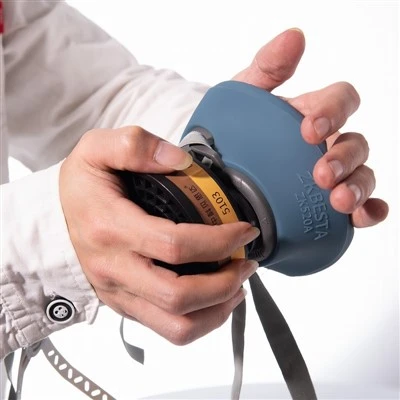
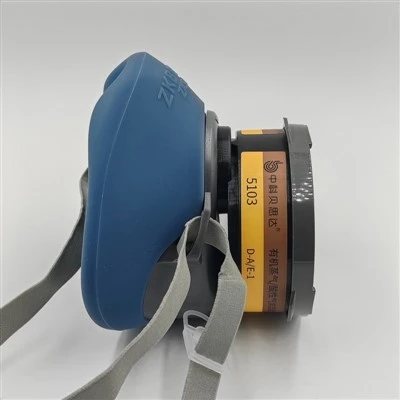
For procurement managers and HSE directors, the decision between a full face and a half face respirator is not a matter of preference but a calculation of hazard level, required protection factor, and total cost of ownership (TCO). While half masks are standard for particulate filtration, full face respirators become mandatory when eye protection is required or when the Assigned Protection Factor (APF) of a half mask is insufficient.
This analysis breaks down the technical specifications, regulatory standards, and commercial implications of both systems to assist in B2B sourcing decisions.
Ⅰ:Protection Factors and Regulatory Standards (EN140 vs. EN136)
The primary differentiator is the Assigned Protection Factor (APF). In the European standard framework (and widely adopted globally), the APF dictates the maximum level of protection a mask can offer.

Half Face Mask (EN 140:1998):
Covers nose and mouth. APF of 10. Suitable for environments where contaminant concentrations are up to 10x the Occupational Exposure Limit (OEL)..
Full Face Mask (EN 136:1998):
Covers eyes, nose, and mouth. APF of 40. Required for concentrations up to 40x the OEL or when eye irritation is a risk.

Technical Comparison: Filtration and Leakage
The following table outlines the critical performance metrics for B2B buyers evaluating compliance.
|
Parameter |
Half Face (EN 140) |
Full Face (EN 136) |
Procurement Implication |
|
Assigned Protection Factor (APF) |
10 |
40 |
Full face offers 4x higher safety margin. |
|
Total Inward Leakage (TIL) |
≤ 8% (Geometric Mean) |
≤ 0.2% (Geometric Mean) |
Full face provides a tighter seal, critical for toxic gases. |
|
Field of Vision |
N/A |
≥ 70% (Binocular) |
Full face ensures peripheral vision for complex tasks. |
|
Eye Protection |
Requires separate goggles |
Integrated polycarbonate visor |
Full face eliminates fogging issues between mask/goggle interface. |
|
Breathing Resistance |
Lower (smaller volume) |
Slightly Higher (larger volume) |
Half mask is preferred for high-cardio exertion. |
Engineering Note: When sourcing from a China manufacturer, verify that the full face mask meets the TIL requirements of EN 136:1998 Class 2 or Class 3. A failure in the TIL test usually indicates poor face seal design or inadequate head harness tension.
Application Suitability: When to Specify Full Face
For HSE managers in chemical processing, painting, or pharmaceutical manufacturing, the half face respirator is often inadequate due to the "eye irritation threshold." Many organic vapors (like xylene or acetone) irritate the eyes at concentrations far lower than those dangerous to the lungs.
Scenarios Requiring Full Face Respirators:
High Concentration Environments: Where airborne contaminants exceed 10x the OEL but are below 40x (IDLH levels require SCBA).
Ocular Hazards: Handling acids, alkalis, or solvents that cause immediate eye damage or blinding.
Nuisance Dust + Vapors: Environments requiring both particulate pre-filters and gas cartridges where face seal integrity is paramount.
ZKBESTA's full face respirator for organic vapor applications, such as industrial painting and chemical processing, demonstrate the necessity of the APF 40 rating. The integration of a wide-field polycarbonate lens eliminates the need for secondary eye protection, reducing PPE inventory complexity.
Technical Specifications: The ZKBESTA Standard
When evaluating a supplier, specifically a CE certified OEM supplier, technical data sheets (TDS) must be scrutinized. Below are the specifications for a professional-grade reusable system, using the ZKBESTA ZK6800 series as a benchmark for quality.

Material & Ergonomics
Face Seal: Liquid Silicone Rubber (LSR). Unlike Thermoplastic Elastomer (TPE), LSR does not harden over time and maintains a seal on diverse facial structures.
Visor: Polycarbonate (PC) with anti-fog and anti-scratch coating. Must pass the impact test (EN 168 F or B rating).
Connection: Standard RD40 thread (EN 148-1) or Bayonet fitting. Note: RD40 is the global standard for interoperability with filters.
Filtration Compatibility
A robust system must support:
Particulate Filters: P2 (94%) and P3 (99.95%) per EN 143.
Gas Cartridges: A1/A2 (Organic Vapor), B1/B2 (Inorganic), E1/E2 (Acid Gas), K1/K2 (Ammonia).
Combo Filters: For simultaneous dust and vapor protection.
Supply Chain and Compliance Verification
For global supply chain managers, verifying the legitimacy of the CE certificate is non-negotiable.
Check the Notified Body (NB): Ensure the 4-digit NB number on the mask matches the certificate.
Verify Regulation: The certificate must cite PPE Regulation (EU) 2016/425, specifically Category III (Complex Design).
Module C2 or D: Category III requires ongoing surveillance (Module C2) or quality assurance (Module D). A Module B certificate alone is expired/invalid for sales.
ZKBESTA Compliance Data:
Certification: Module C2 Production Monitoring.
Standard: EN 136:1998 (Full Face), EN 140:1998 (Half Face).
Factory Audit: ISO 9001:2015 (Quality), ISO 14001 (Environmental).
FAQ
Q: What is the standard MOQ for OEM full face respirators with custom branding?
A: For professional-grade full face respirators, the standard MOQ for silk-screen logo printing is typically 500 units per model. For custom mold modifications or packaging, the MOQ may rise to 2,000 units. Lead times generally range from 15 to 25 days after deposit.
Q: Are your organic vapor cartridges compatible with other major brand masks?
A: ZKBESTA utilizes the RD40 standard thread (EN 148-1) for our full face masks and bayonet fittings for half masks, which are industry standards. However, for specific proprietary bayonet systems, we recommend testing a sample to ensure an airtight seal before bulk procurement.
Q: Can you provide the EU Declaration of Conformity (DoC) for customs clearance?
A: Yes. As the manufacturer, ZKBESTA provides the full technical file, including the EU Type-Examination Certificate (Module B) and the Declaration of Conformity (DoC) signed by the authorized representative, which is required for customs clearance in the EU and UK markets.