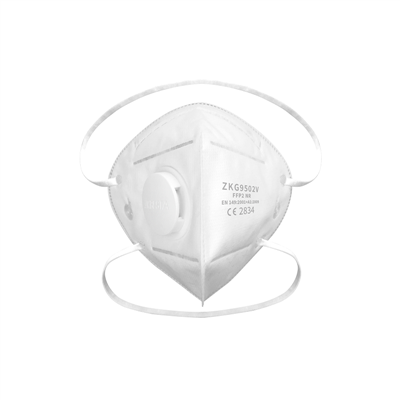
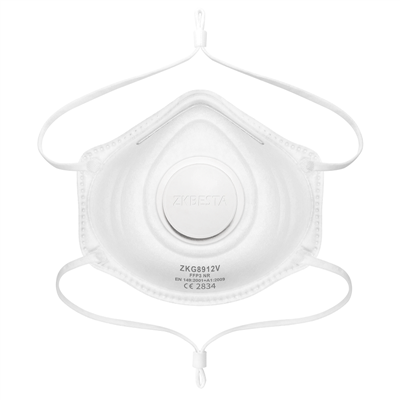
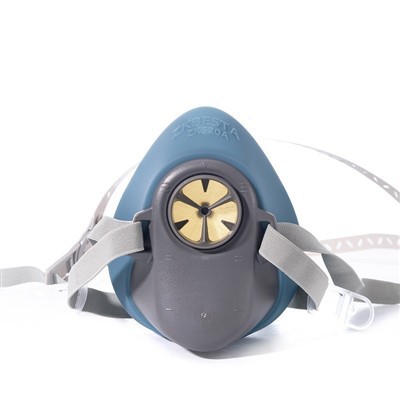
A respirator's protection factor is entirely dependent on the face seal. Even a filter with 99.97% efficiency (P3/FFP3) fails if the mask leaks. For procurement and HSE managers, verifying seal integrity involves two distinct phases: User Fit Testing (quantitative/qualitative checks per EN136/EN140) and Factory Quality Control (visual and negative pressure verification). This guide details the technical protocols for both to ensure your PPE inventory meets safety compliance.
1. The Physics of the Seal: Why Material Matters
The primary cause of respirator failure is not filter saturation, but face seal leakage. In industrial environments (chemical, mining, construction), the "Total Inward Leakage" (TIL) must remain below regulatory thresholds (e.g., ≤2% for FFP3).
To achieve this, the interface between the mask and the skin must maintain a hermetic seal despite facial movement and temperature fluctuations.
The Role of Liquid Silicone Rubber (LSR):
Unlike traditional Thermoplastic Rubber (TPR), high-purity Liquid Silicone offers distinct physical advantages for sealing:
Hypoallergenic & Non-irritating: Critical for extended wear (8+ hour shifts).
Thermal Stability: Maintains elasticity between -10°C and 40°C. It resists hardening in cold storage or softening in high-heat environments, unlike standard rubber which suffers from ozone cracking and UV degradation.
Surface Tension: LSR conforms better to micro-contours of the face (nasal bridge, chin cleft), reducing the gap size to near zero.
2. User-Side Verification: Positive & Negative Pressure Checks
Before entering a hazardous zone, workers must perform a Seal Check (often confused with a Fit Test). While a Fit Test is a formal OSHA/EN procedure, a Seal Check is a quick user verification.
A. Negative Pressure Test (Suction Test)
This is the standard method to verify the seal integrity of a half mask respirator.
Block Inlets: Cover the filter cartridge inlets with the palms of your hands (or block the hose if using a PAPR).
Inhale Gently: Breathe in slowly. The facepiece should collapse slightly against the face.
Hold Breath: Hold for 10 seconds.
Evaluation: If the facepiece remains collapsed and no air leaks are felt around the seal, the fit is adequate. If air enters, adjust straps and repeat.
B. Positive Pressure Test (Exhalation Test)
Block Exhalation Valve: Cover the exhalation valve cover with your hand.
Exhale Gently: Breathe out slightly.
Evaluation: Slight pressure should build inside the facepiece. If air leaks out around the nose or chin, the seal is compromised.
⚠️ Note: These checks do not replace Quantitative Fit Testing (QNFT) using a PortaCount, which measures the actual Fit Factor (FF) required by safety regulations.
3. Factory-Side QC: How ZKBESTA Ensures Seal Integrity
For procurement directors and supply chain managers, understanding the manufacturer's QC process is vital for risk mitigation. A "customized" mask is only as good as the mold precision and assembly line checks.
At ZKBESTA, the manufacturing of silicone reusable half masks involves rigorous AQL 2.5 sampling standards and specific seal verification protocols.
Production Line QC Protocol:
|
QC Stage |
Inspection Method |
Acceptance Criteria |
Standard Reference |
|
Visual Inspection |
Laser Calipers & Manual Check |
No flash, bubbles, or surface defects on the sealing rim. |
ISO 9001 |
|
Dimensional Accuracy |
3D Scanning / Calipers |
Critical sealing dimensions within ±0.1mm tolerance. |
Internal Spec |
|
Seal Integrity Test |
Negative Pressure Chamber |
Mask maintains vacuum for 10 seconds without pressure rise. |
EN 140 / EN 136 |
|
Strap Tensile Test |
Tensile Strength Machine |
Headband elongation < 10% permanent set after load. |
EN 140 |
|
Pre-conditioning |
Thermal Cycling |
Stability verified after exposure to -30°C and +70°C. |
Internal Spec |
The "Negative Pressure" Factory Test:
Every batch undergoes a negative pressure test simulation. The mask is sealed against a test head form. A vacuum is drawn. Sensors monitor the pressure decay. If the pressure rises (indicating a leak in the mask body or seal), the unit is rejected. This ensures that the Classic Bayonet Interface and the silicone body are fused perfectly.
4. Technical Specifications & Compliance
When sourcing silicon reusable half mask respirators, technical data sheets (TDS) must be verified against EN standards.
Key Performance Indicators for ZKBESTA Half Masks:
- Shell Material: Liquid Silicone (LSR) – ensures long-term elasticity.
- Service Life: 5 Years (EXP) – significantly higher ROI than disposable masks.
- Breathing Resistance: ≤60Pa (Inhalation). This is well below the EN 140 limit of 300Pa (at 30 L/min), reducing worker fatigue.
- Interface: Bayonet (BX) compliant with EN 148-1. Compatible with A1, B1, E1, K1, and P3 filters.
- Weight: 280g (without filters) – balanced dual-canister design reduces neck strain.
- Certification & Traceability:
- CE Marking: Compliant with EN 140:1998 (Half masks).
- Filter Standards: Compatible with filters meeting EN 14387 (Gas) and EN 143 (Particles).
- Traceability: Full traceability to NANDO-listed Notified Body entities.
5. Application Scenarios
The seal integrity of a half mask is tested across various industrial applications to ensure versatility.
Chemical Manufacturing: Requires a tight seal against organic vapors and acid gases (using ABEK cartridges).
Paint Spraying: Protection against solvent fumes and paint overspray.
Metal Processing: Filtration of metal fumes and grinding dust (paired with P3 filters).
Agriculture: Protection during pesticide application where dermal and respiratory sealing is critical.
FAQ
Q: How does the factory verify the seal on a silicone half mask during production?
A: We utilize a negative pressure integrity test on a statistical sampling basis (AQL 2.5). The mask is placed on a test head form, a vacuum is applied, and pressure decay is monitored. Additionally, 100% visual inspection ensures the silicone sealing rim is free of defects that could cause leaks.
Q: Is your bayonet interface compatible with standard EN148-1 filters?
A: Yes. Our half masks feature a Classic Bayonet (BX) interface compliant with EN 148-1. They are fully compatible with standard European filter cartridges (Class A, B, E, K, and P) without the need for adapters.
Q: What is the Minimum Order Quantity (MOQ) for OEM custom logos?
A: The standard MOQ for custom logo pad printing is 1,000 pieces. We support Pantone color matching for the silicone body and provide pre-production samples for approval within 7 days.